Streaming guide
kymora.StreamingExtractor maintains a rolling window of window_size
samples for one live series. push(value) ingests one sample;
compute(kind="fast" | "all") reads features out of the current window.
Complexity contract
| Operation | Cost | Notes |
|---|---|---|
push |
O(1) amortized | All accumulators update in place. An exact O(W) re-anchor pass fires at most every min(anchor_interval, ~6% of W) pushes (see below). |
compute(kind="fast"), all 12 features |
O(1) | Pure accumulator reads: no window scan, no allocation, no sorting, no FFT. |
compute(kind="fast") on a window containing ±inf |
O(W), exact | Rare degenerate path: runs the batch pipeline on the materialized window so output matches batch by construction. |
compute(kind="all"), all 33 features |
O(W)-plus | The exact batch pipeline on the current window (quantiles, spectral, entropy need the full window). |
Per-feature tier for compute(kind="fast"):
| Feature | Tier | How |
|---|---|---|
mean, std, var, skewness, kurtosis |
O(1) | Anchored shifted power sums + binomial expansion (see below) |
abs_energy, root_mean_square |
O(1) | Exact expansion of the anchored sums |
mean_abs_change, mean_change, cid_ce |
O(1) | Running successive-difference accumulators |
zero_crossings |
O(1) | Exact running counter (batch >-on-both-sides convention) |
trend_slope |
O(1) | Anchor-relative trend accumulator (no offset cancellation) |
| quantiles, spectral, entropy, autocorrelations, peaks, strikes | O(W), kind="all" only |
Need the full ordered window or its spectrum |
MultiStreamExtractor.push_many updates every stream's O(1) tier (mean, std,
var, energy, RMS, crossings from raw running sums) in one lane-parallel pass.
Note: the fleet tier uses raw power sums, so on large-offset series
(|mean| >> std) prefer per-stream StreamingExtractor or the exact
kind="all" path.
How the O(1) moments stay accurate
Raw power sums (Σx², Σx³, …) cancel catastrophically on series like
1e9 + noise. The extractor instead keeps anchored shifted sums
s_k = Σ(x − anchor)^k, where anchor is the exact window mean at the last
re-anchor. Central moments come from the binomial expansion, which is accurate
while the mean stays near the anchor. Two guards enforce that:
- Periodic guard: exact re-anchor every
anchor_intervalpushes (default 4096, configurable via the constructor orset_anchor_interval). One O(W) pass in batch summation order, so the anchor bit-matches the batch mean and error never compounds. - Drift guard: re-anchor as soon as the window mean has drifted more than a quarter of a standard deviation from the anchor. On ordinary data this fires about every 6% of the window, which keeps the expansion accurate to ~1e-13 relative — far inside the 1e-9 streaming-vs-batch tolerance — while staying O(1) amortized. Strongly trending series re-anchor more often; correctness never depends on the data cooperating.
The trend accumulator stores anchor-relative deviations (Σ i·(x − anchor)),
so the slope is exact even when Σ i·x would cancel (large offset).
Accuracy contract
Streaming-vs-batch agreement on the same window (float64):
- Random, trending, constant, small-variance, and large-offset windows: every fast feature matches batch within rtol 1e-9, except skewness/kurtosis on large-offset windows (see below).
- Constant windows:
var/stdare exactly 0, skew/kurt NaN, slope exactly 0 — same as batch. - NaN in the window → all-NaN row (batch contract). ±inf in the window → exact O(W) fallback, output matches batch by construction.
- Window not yet full → all-NaN. Window size 1: diff-based features are NaN exactly where batch leaves them undefined on length-1 input.
- Skewness/kurtosis on large-offset windows (e.g.
1e9 + noise): bounded absolute agreement of 5e-6 (Rust) / 1e-5 (Python, longer stream). This is a floating-point conditioning limit, not an implementation defect: ulp(1e9) = 1.19e-7 already quantizes every stored sample, and the batch mean itself carries ~1e-8 absolute error which m3/m4 amplify ~60–100x. The streaming center is the more accurate of the two: against the true moments of the stored (quantized) values it agrees to 1e-9. Proven byfeatures::streaming::tests::anchored_fast_matches_batch_large_offset.
Measured latencies
Artifact: benchmarks/results/2026-10-05_streaming/ (suite
benchmarks/suites/streaming.py, B3; every capacity parity-gated before
timing). Exploratory single-machine numbers (i7-13620H, Windows 11, single
thread), not fleet evidence:
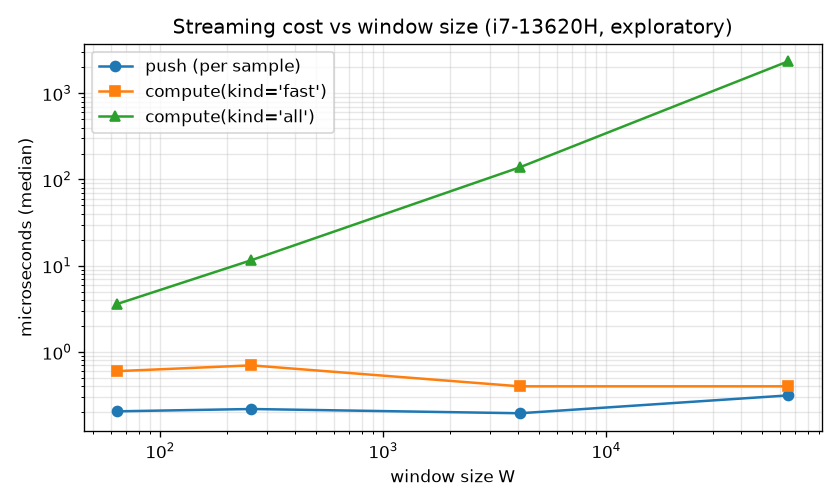
| W | push (µs) | compute fast p50 (µs) | compute all p50 (µs) | naive recompute p50 (µs) |
|---|---|---|---|---|
| 64 | 0.205 | 0.60 | 3.6 | 438.1 |
| 256 | 0.218 | 0.70 | 11.6 | 300.9 |
| 4096 | 0.195 | 0.40 | 138.5 | 494.1 |
| 65536 | 0.314 | 0.40 | 2350.0 | 6076.8 |
End-to-end (W=256, 99,744 points, fast compute every 64): streaming 0.030 s
vs naive full recompute 0.432 s = 14.4×. push and compute(fast) are flat
across 64…65536 (O(1)); compute(all) grows linearly (O(W)).
Re-run the suite on your hardware before quoting numbers.
Example
import numpy as np
from kymora import StreamingExtractor

rng = np.random.default_rng(0)
stream = StreamingExtractor(window_size=500)
for tick in rng.standard_normal(600):
    if stream.push(float(tick)):
        fast = stream.compute(kind="fast")  # 12 features, O(1)
full = stream.compute(kind="all")  # 33 features, O(W) exact